 Bear Liu
The restraint of Apple Health: how a difficult app helps Apple sell the next Apple Watch
Apple Health feels cluttered, passive, and short on guidance. Those weaknesses point to an overlooked premise: Apple treats it as health infrastructure for its hardware ecosystem. Its real value is storing years of data, building trust, and making it harder to leave the iPhone and Apple Watch behind.
An app with poor reviews, a confusing home screen, buried features, and almost no guidance would normally be considered a design failure. Apple Health has nearly all of those problems.
Yet it comes installed on every iPhone, stores years of increasingly sensitive health information, and supports one of the strongest reasons to keep buying an Apple Watch.
That makes the real question more interesting: is Apple Health simply an underwhelming health app, or have we been judging it against the wrong standard from the beginning?
It behaves more like a system component than an app
Most of the products I analyse are things people actively choose to download, buy, and use. Apple Health is unusual because almost nobody deliberately chooses it.
You buy an iPhone, and it is already there. Once you start using an Apple Watch, it quietly begins accumulating your steps, heart rate, sleep, workouts, and other health information in the background.
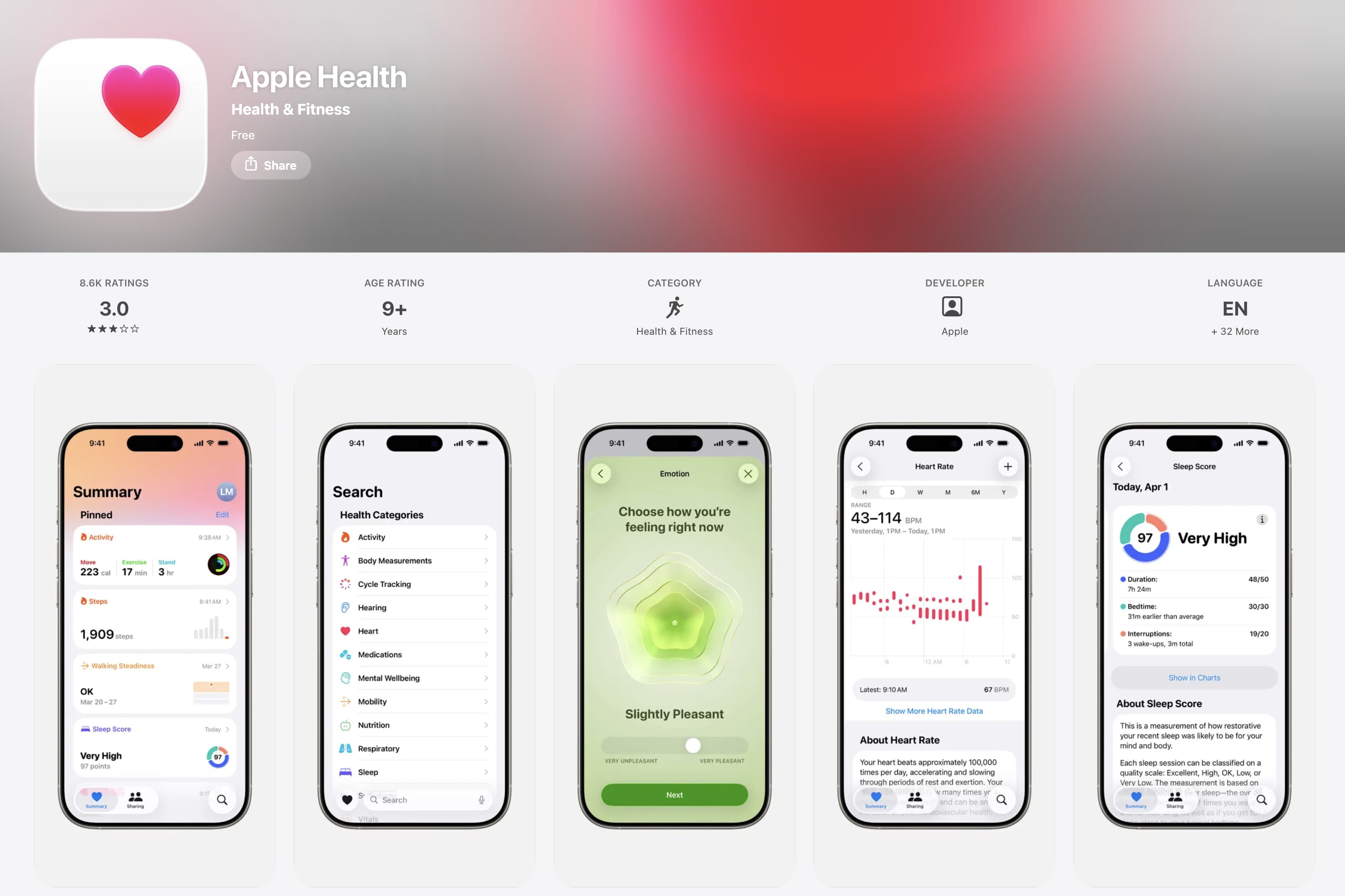
In that sense, it is closer to Settings, Contacts, or a file manager. We do not open these tools because they are exciting. We simply expect them to remain reliable and be available when we need them.
The problem is that people still judge Apple Health as though it were a product like Fitbit or Whoop.
Open Fitbit and you will see sleep scores, recovery information, and suggested actions. It tells you how you slept, whether today is a good day to exercise, and which parts of your health have changed.
Open Apple Health and you get a long Summary page containing pinned metrics, trends, alerts, and educational articles. Move into Browse, and you find categories covering activity, body measurements, hearing, heart health, medications, nutrition, sleep, symptoms, and vital signs.
The difficulty is not simply that there are too many categories. The deeper problem is that they are organised according to different systems.
Heart, respiratory health, and hearing are parts of the body. Activity, sleep, and nutrition are behaviours. Symptoms, medications, and vital signs belong more naturally to a clinical model.
The user is left trying to form a clear mental map from several competing structures.
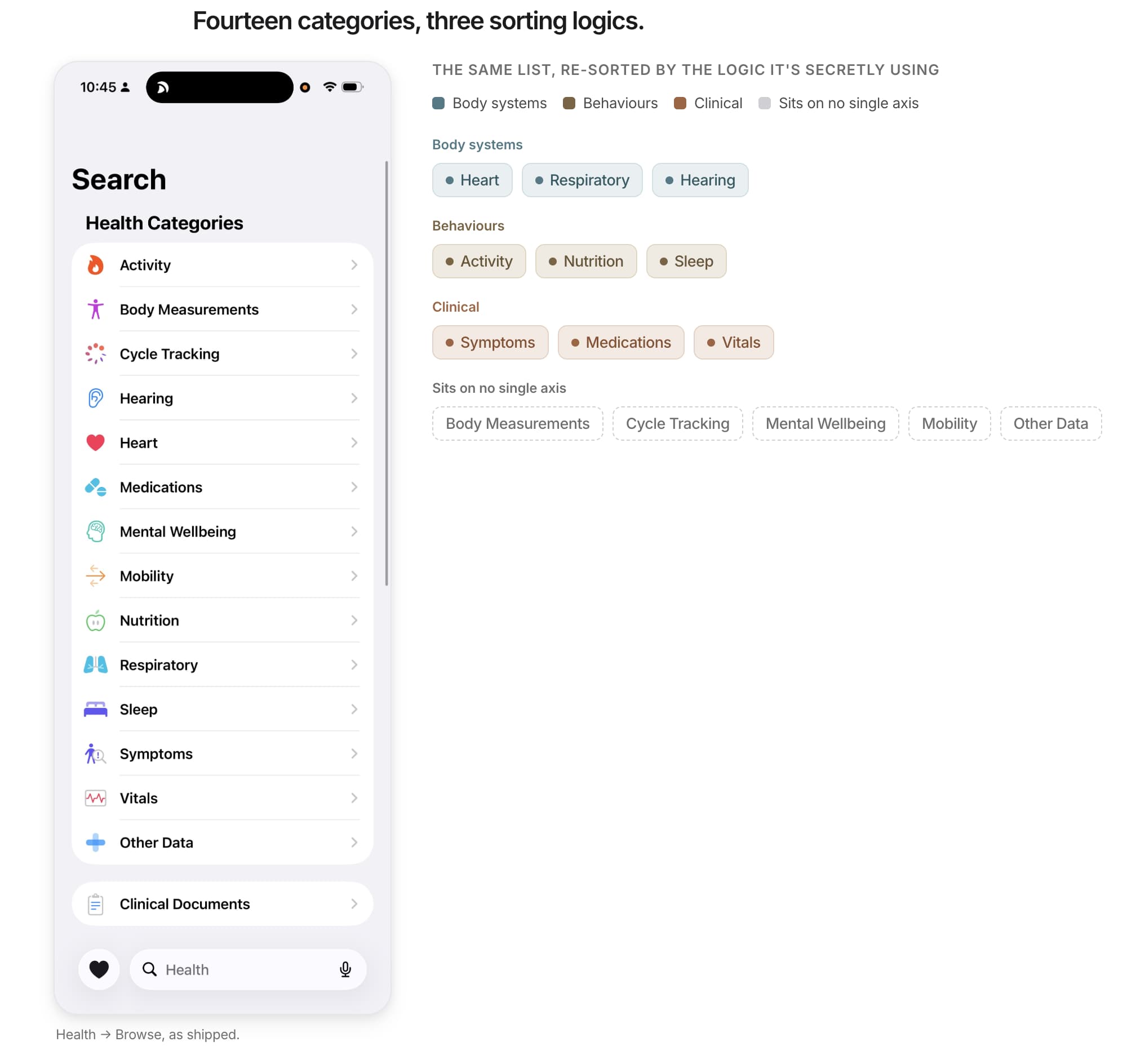
A typical consumer product would solve this by reorganising the interface around goals such as sleep, fitness, or cardiovascular health. Apple instead keeps most of the data inside a relatively neutral container and asks users to decide what they want to pin and follow.
From the perspective of everyday usability, that is not an ideal choice. From the perspective of infrastructure, it is much easier to understand.
Products want you to return. Infrastructure wants you to forget it
Most consumer products are measured by engagement, retention, and time spent. Their teams want users to come back tomorrow and stay a little longer.
Infrastructure is measured differently.
We do not open our cloud backup every morning to check whether it is still working. We do not repeatedly turn on a tap to admire the plumbing. Infrastructure creates value by being stable, trustworthy, and unobtrusive. Most of the time, we should barely notice it.
A product wants you to keep returning. Infrastructure wants you to feel comfortable forgetting about it.
Apple Health is much closer to the second model.
It has to accommodate more than 150 kinds of health data from the iPhone, Apple Watch, third-party devices, fitness apps, manual entries, and medical institutions. All of this information eventually flows into HealthKit, the health data layer Apple maintains on the device.
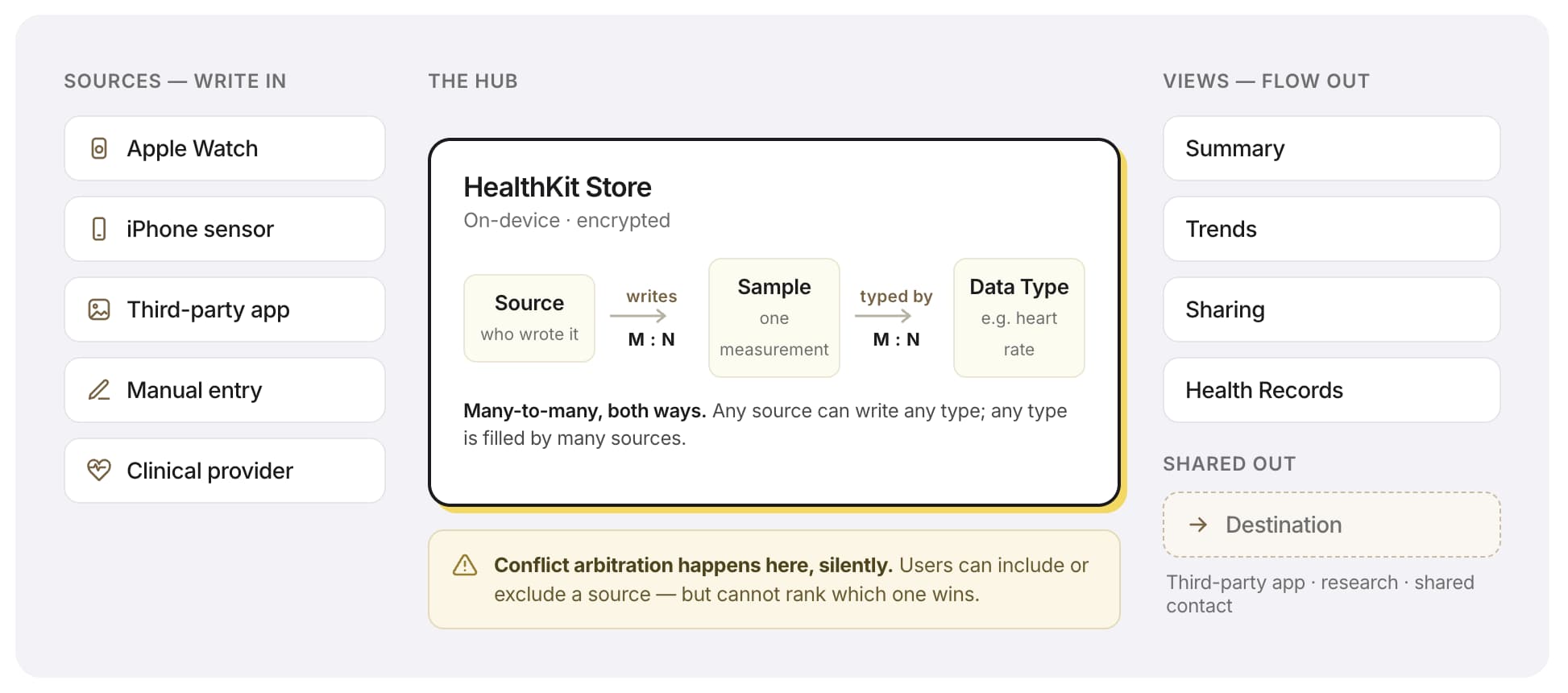
That structure gives Apple Health enormous compatibility. A hospital record, a heart-rate reading from an Apple Watch, and a manually entered weight can all live in the same place.
The cost is that Apple Health cannot offer the same stable, carefully composed dashboard as Fitbit.
Most Fitbit data comes from Fitbit hardware, so the product can decide which information matters most and in what order it should appear. Apple Health has to remain relatively neutral. It cannot organise the entire experience around one device, one health goal, or one philosophy of wellbeing.
When the central job of a product is to aggregate information, the home screen can easily turn from a health story into a data warehouse.
The capability that makes Apple Health valuable is also responsible for its most obvious usability problem.
Interfaces are not always expressions of a designer’s taste. Sometimes they are simply the underlying structure of the product becoming visible.
Apple is quiet because it sells hardware
Most information inside Apple Health arrives automatically. Apple Watch records heart rate, activity, and sleep in the background, while third-party devices can continue adding their own data.
Apple Health rarely asks you questions. It does not constantly request feedback or ask whether a recommendation was helpful.
Google’s health products take a very different approach.
When I used Fitbit and Google Health, the product analysed my deep sleep, asked why I might have woken up during the night, and invited me to rate whether its recommendations were useful. Almost every screen could become an opportunity to collect another signal.
It is tempting to describe this as a difference in design philosophy. Apple is quiet, while Google is active and conversational.
The more important difference is the business model.
Google’s business depends heavily on understanding data and behaviour. It has a strong reason to keep asking questions, observing responses, and using that information to improve its models and services.
Apple earns most of its money through hardware and services. A user’s health behaviour is not itself the product Apple needs to sell. What Apple needs to protect is the user’s willingness to place highly sensitive data inside its ecosystem.
Fewer questions, fewer interruptions, and more on-device processing therefore become part of the value proposition.
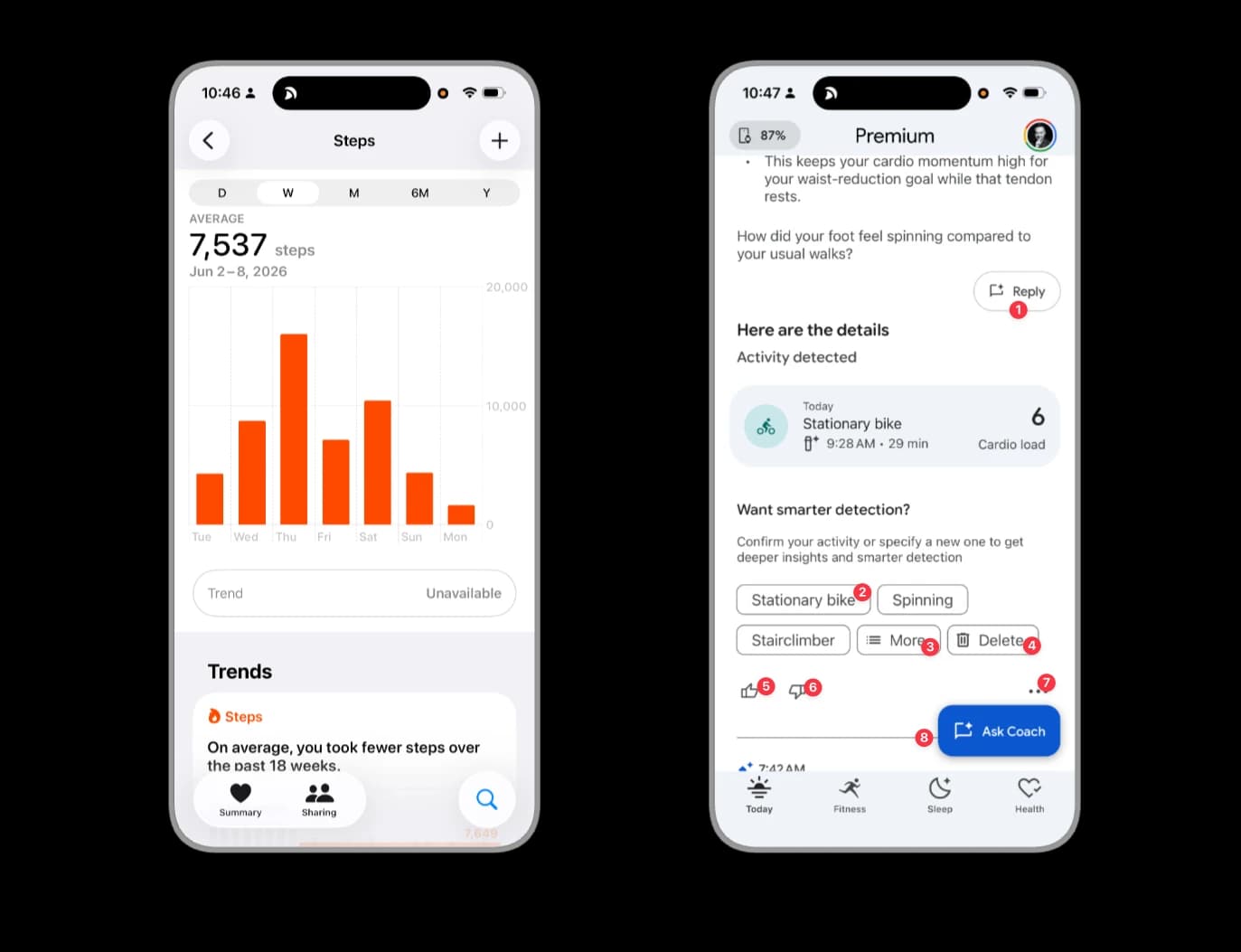
Whether an interface is quiet or talkative can often be explained by how the company makes money.
When a product constantly asks for ratings, feedback, and personal information, it is worth asking why the company needs so much behavioural data.
For Apple Health, the commercial answer sits outside the app.
The free app is selling the next Apple Watch
Apple Health is free, and it would be difficult for Apple to charge for it directly.
That does not make it a simple giveaway. Health technology requires long-term investment in engineering, privacy, medical partnerships, research, and regulatory approval. Apple is clearly expecting a return somewhere else.
That return comes from hardware.
Apple Watch shipments fell by 19 percent in 2024, marking a second consecutive annual decline. As the smartwatch market matures, incremental improvements such as a brighter screen or faster processor are becoming less persuasive reasons to upgrade.
Health capabilities are taking on a larger role.
From ECG and AFib History to sleep apnoea detection and hypertension notifications, Apple has continued moving the Watch closer to the territory of a medical device. Each clinical study and regulatory approval increases confidence in the data the Watch collects and in Apple Health as the place where that data can be stored over time.
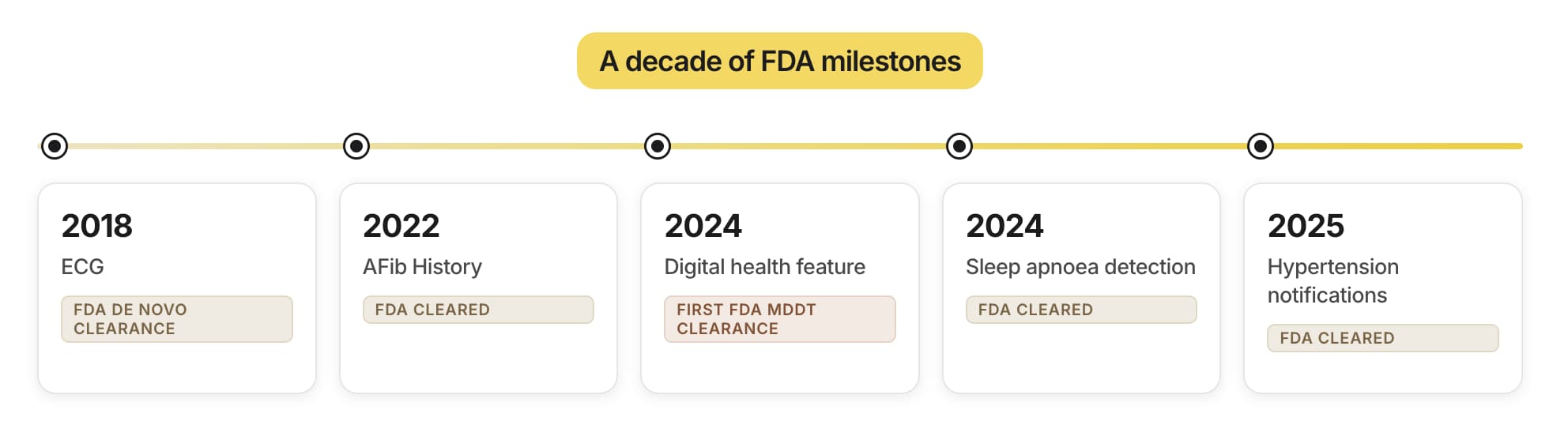
Once a person has accumulated five or ten years of heart-rate history, sleep data, exercise trends, medication information, and medical records inside Apple Health, leaving the ecosystem becomes more expensive.
The cost goes beyond buying a different phone. Years of health history may not transfer cleanly, third-party devices may need to be reconnected, and family-sharing relationships may be disrupted.
Apple Health therefore creates two forms of retention.
The first comes from the switching cost of historical data. The second comes from the trust Apple has built through privacy, medical research, and regulatory approval.
Apple Health looks like a free health app, but its real job is to keep people buying iPhones and Apple Watches.
This also explains why Apple has to remain restrained.
If Apple Health began aggressively promoting services, requesting feedback, or using anxiety to push people into opening it every day, it might improve engagement. It could also damage something far more valuable: trust in the container holding years of personal health information.
Its quiet, low-commercial posture is what allows the retention system to keep working.
The design still has two visible cracks
Apple Health depends on trust, but the user’s control over the data remains limited.
The same heart-rate metric might be written by an Apple Watch, Nike Run Club, a Withings device, and several other fitness apps. Users can disable a third-party source and prevent it from contributing new information.
The problem appears when two valid sources disagree.
Users cannot set one device as more trustworthy than another, and Apple does not clearly explain how the final result is chosen.
You can decide who is allowed into the room, but you cannot decide who gets the final word when they disagree.
Apple has probably decided that a simple on-and-off switch, followed by automatic merging, is easier for most people to understand than a complicated source-ranking system.
That reduces complexity, but it also creates a gap in the trust story. As health data is used for more serious decisions, users may need to know where a number came from and why the system accepted one result over another.
The second crack is that Apple Health’s most valuable capabilities are often difficult to find.
Health Sharing can turn a personal health tool into a family network. Health Records can connect the app to hospitals and clinical information. Yet many users are unaware that these features exist.
Infrastructure naturally hides complexity, in the same way a building hides its electrical panels and pipes. But a product still has to help people discover its value.
Apple keeps the surface calm by hiding complexity, and in doing so makes some of its hardest-to-copy capabilities almost invisible.
Why most companies should not copy Apple Health
“Be restrained”, “reduce interruption”, and “let the product work quietly” have become popular pieces of product advice.
Apple Health shows why that advice can be dangerous.
Apple can afford to keep the app free, low-frequency, and minimally interactive because the iPhone, Apple Watch, and services business make money underneath it. Apple Health protects trust in the ecosystem, and that trust eventually turns into hardware revenue.
An independent health startup would face a very different outcome.
Imagine a product that does not charge, does not remind users to return, rarely demonstrates its value, and hides its best features inside a complicated information structure. Without another commercial layer paying for that restraint, the likely result is low engagement and weak revenue.
Infrastructure-level restraint only becomes sustainable when there is a clear commercial layer underneath it.
Apple can afford to be quiet because the Apple Watch is doing the selling.
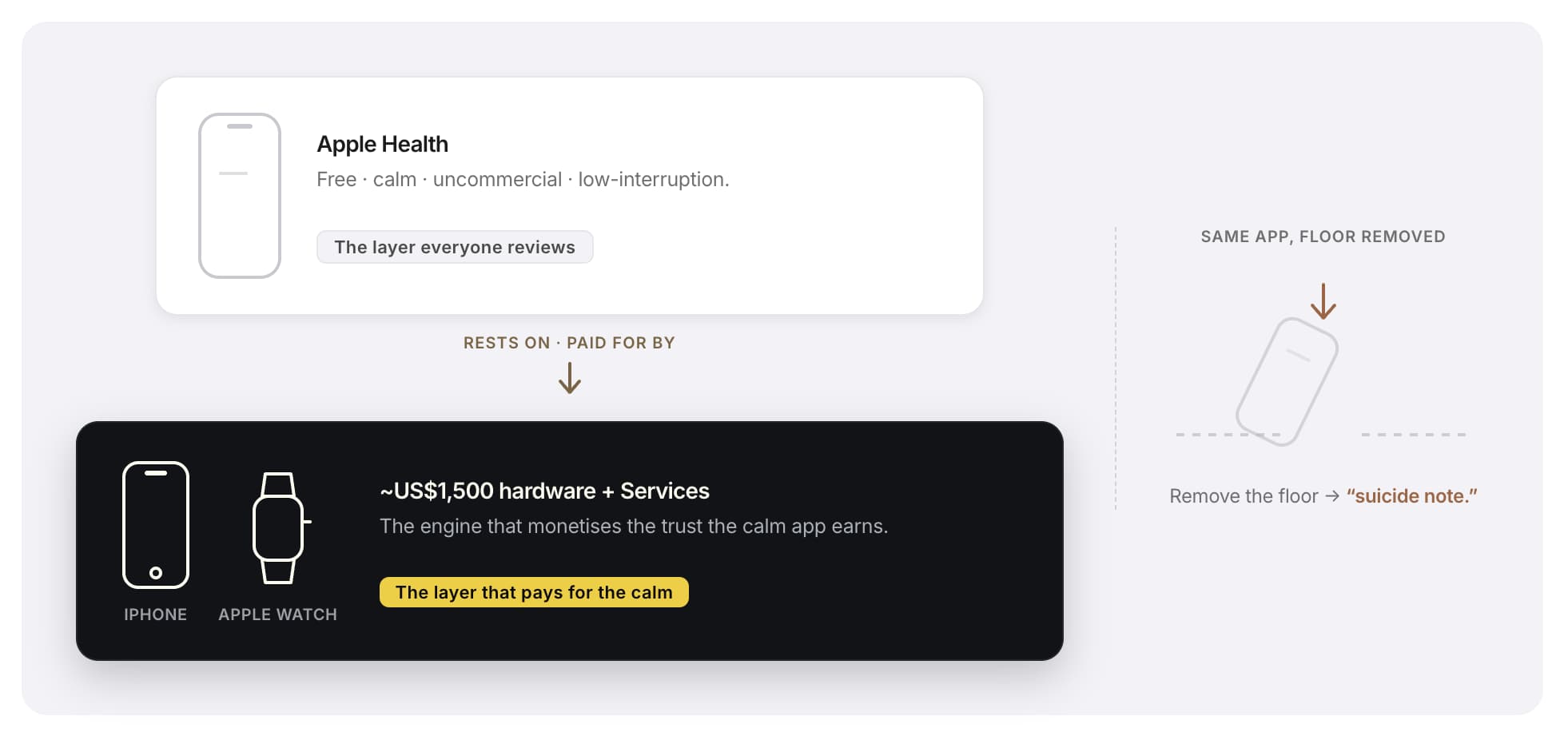
Before copying Apple’s restraint, a team needs to find its own Apple Watch: the product, service, or business model that receives the commercial return.
Without one, quietness may simply become another name for a lack of growth.
An interface is a business model made clickable
When Apple Health and Google Health are placed side by side, it becomes difficult to say that one is simply better designed.
Apple Health is a container. It values compatibility, privacy, long-term accumulation, and stability. It can continue doing its job even when users rarely open it.
Google Health behaves more like a coach. It analyses data, gives advice, asks follow-up questions, and collects feedback. Users need to return, and the product needs to keep learning about them.
One stores. The other interprets.
Their interfaces reflect two different businesses.
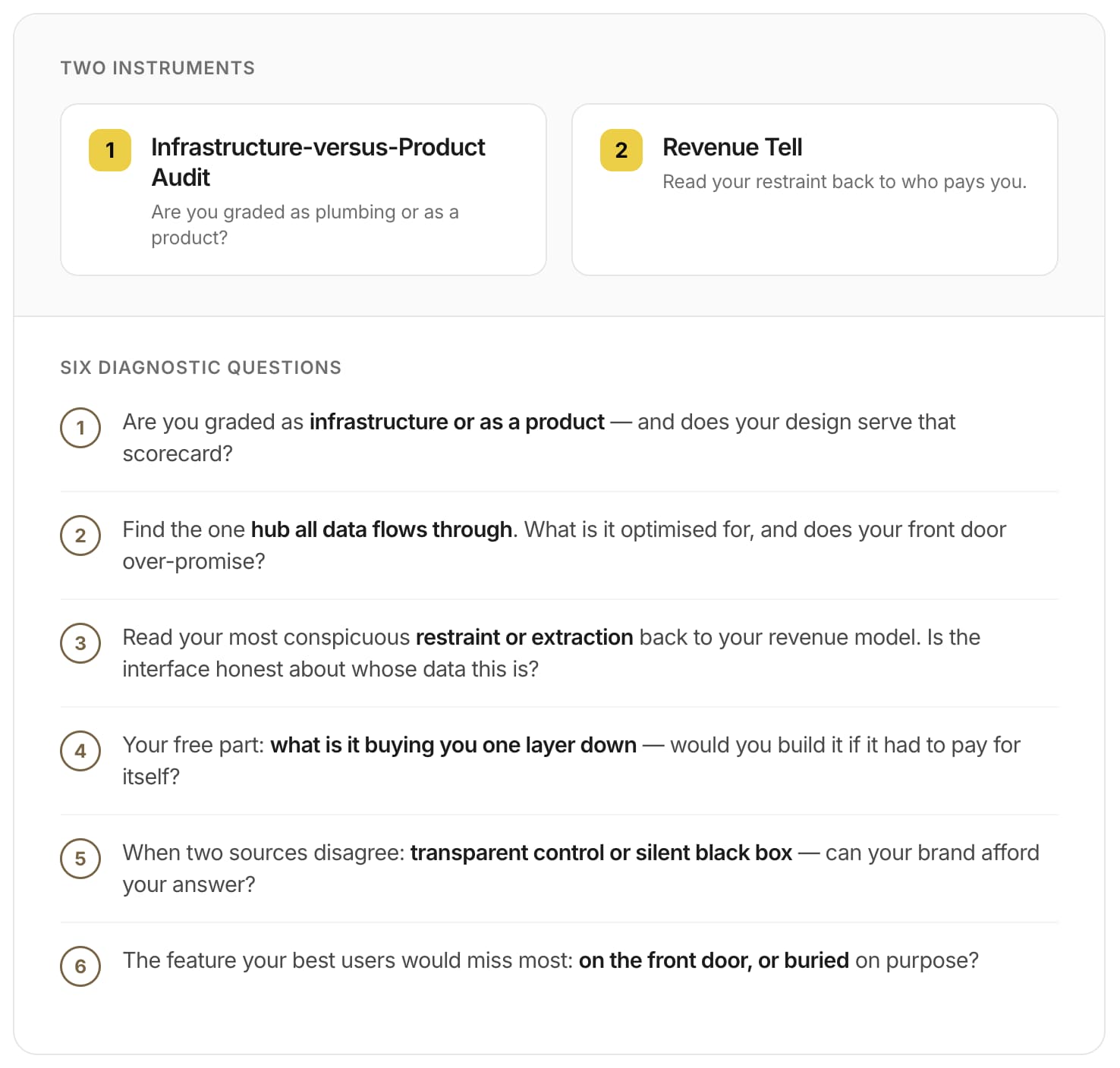
The useful lesson from Apple Health is therefore not a verdict on whether Apple has done a good or bad job. It is a set of questions we can bring back to our own products.
Does your product need users to open it frequently, or does it mainly need them to trust it over time?
Which part of the business is your free product actually supporting? Would you make the same design choices if it had to generate revenue on its own?
When the system handles complexity on behalf of the user, can the user still understand the decisions it makes?
Are your most valuable capabilities clearly visible, or are they hidden where only advanced users will find them?
The most interesting thing about Apple Health is that the same design decision can produce poor reviews and strong commercial value at the same time.
Its confusing home screen disappoints many users, but it also allows the system to remain relatively neutral and accommodate information from different devices and institutions. Its lack of active guidance makes it feel less engaging than a typical health app, but also helps create a quiet environment that people may trust for many years.
Apple accepts the criticism because the real goal sits outside the app.
Apple Health succeeds by making people believe their health history can safely remain there for a decade. As long as that trust continues, selling the next Apple Watch becomes easier.
The app may feel underwhelming, and at times genuinely difficult to use.
But it may also be doing exactly the job Apple designed it to do.
If any of those questions landed without a clean answer, that gap is worth a closer look.
I write diagnoses like this one for other products: where your design is quietly serving the wrong outcome, what that is costing you, and what to change first. If you would like one for yours, email me at hi@bearliu.com.